Pages

Showing posts with label reflection. Show all posts

Wednesday, 18 February 2015

Teaching Skills: Peer Support Course - Day 1

During the introduction on day 1, we emphasized the peer support element of the course. We felt it was important that participants learnt from each other.  Alongside this we asked that everyone contributed in order to get the most out of the program.

very confident----------------little confidence
Before starting we wanted to gauge participants experience in delivering teaching sessions and more importantly their confidence in teaching. as we wanted to measure their confidence after the course and 3-6 months later to see if there was a longitudinal improvement. We measured both experience and confidence using "string theory"; literally a long piece of string placed along the floor, one end being very experienced/confident and the other end being little experience/confidence.  We then asked participants to position themselves along the line and to write their name on a post it note, which we then collected up in order.

Our first session used a story technique developed by the English Faculty Library to identify who are students were, what their skills were and what we should teach them. The skills were then linked to ANCIL Information Literacy strands. There wasn't time to cover Information Literacy in depth but links were given to the main theories, such as ANCILSCONUL 7 PillarsInformAll, etc, for participants to look at in their own time.

We then discussed the importance of learning styles in relation to the students learning and the way in which we choose to deliver our teaching sessions, as our own preferred learning style may have a bearing on our teaching.  We found out our own learning styles by using an activity example from Gravells, thinking about how you learned to use a new mobile phone.  This was a very quick and dirty method of demonstrating Honey & Mumford's learning styles: activist, reflector, theorist and pragmatist and I felt it worked really well without taking up too much time. We also looked at what exercises went best with each style and that it was best to use a mixture whilst delivering our sessions, to ensure we included all the students.

The rest of the first day's content looked at lesson planning, smart objectives, teaching methods and session evaluation.  The importance of having a session plan was discussed in order to give structure and confidence by ensuring that all the elements of a session were thought about in advance. Catherine also mentioned that creating one standard plan and re-using it saved time overall.  Key elements to this were the the learning aims and objectives.  Aims should state the purpose of the session and the learning need being met.  Objectives show the students the knowledge they should be able to take away at the end of the session.  These should be:

SMART objectives
are they clearly defined?

how will you know they've been met?

can they be met by your participants?

do they relate to the aim and needs of the participant?

can they be achieved in the time available?


The merits of different types of teaching method, such as lectures, demonstrations, discussions and assorted practical activities were discussed among the participants as an interactive activity. Participants were asked to think of advantages and disadvantages of  using each one from both the teacher and learner perspective.

Assessment methods were also talked about, as its important to know how you will assess the learners knowledge.  This is sometimes something which is perhaps left out when designing library sessions due to time practicalities, so choosing something suitable is vital.  Practical activities, quizzes, discussions, question & answer and group work can all be done during the session with time given for feedback and explanations of the answers.  Online assessment, peer assessment and learner presentations take longer as preparation time is needed by either the teacher or learner.  However once set up, this type of assessment can give more useful feedback on how the learner has processed the information given.

We finally introduced the idea of reflective practice by asking the participants to reflect on the sessions they'd seen and the different speakers. We deliberately used a variety a speakers throughout the course, so participants were able to see different delivery styles and methods. We wanted participants to see that each person has their own unique presentation style and that it was possible to get ideas for teaching from watching other presentations and presenters.

The participants evaluation of the first day was very positive which we were pleased about, especially the fact that they had liked the variety of speakers.  The Story technique was also very popular, one participant said "it was inspiring and interesting".  The planning team felt this was a great interactive session which was different to the usual lecture style of delivery and we are hoping to use it again this summer if we re-run the course.

The things to improve we took away to work on for day 2 were; an activity audit of what was already being done within Cambridge, the use of too many post it notes and the positioning of the projector which meant we had to stand in front of the screen.  However these are all things which the participants in turn will need to think about when delivering their own sessions.  Handouts and whether to give them before or after a session seemed to be split into the yes and no camp.  I don't think there is any right or wrong answers, it just depends on the individuals taking your course on that particular day.


References
Gravells, 2013, The award in education and training, Sage.

Honey & Mumford, 2006, Learning Styles questionnaire: 40 item version, Peter Honey Publishing.

Thursday, 29 July 2010

Librarian's blog, star date July 2010, subject - reflection

(Cue Music) Your mission should you choose to accept it, is to boldly go where no librarian has been before................

Back in May, a new force was gathering on the horizon - Cam23things, whose remit was to guide librarians through the Web 2.0 world and allow us to explore new technologies that may have an impact on our library world. 
by Tiger Lilly
I for one had heard of Web 2.0, and was aware of lots of librarians engaging in certain web based activities, trying to see what all the hype was about.  After starting on the course, it soon became clear that it wasn't just about adding a shiny button to the library page!

Half way through, look how far we've come. We've looked at RSS feeds, various Google applications, tagging, bookmarking, slideshare, Doodle, Calendars, using images and Twitter.  Some of which I found better than others.  I can definitely see a value for libraries in Google reader, RSS feeds and Twitter, for keeping up to date with current awareness and bookmarking for remote access to websites you've found and want to subsequently use in an assignment.  I can also see that tagging has a role to play for our users, as they may want to organise the information we provide in a different way that's more accessible for them.  However I'm still finding it hard to see a use for Doodle, calendaring, Flickr and slideshare.  I'm still of the belief that, if your not a fan of a technology, don't use it, as it won't come across well with your users.

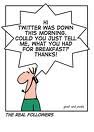
I think the most scary thing for me about this program was The Blog. Worrying about what to write, putting all these new technologies into perspective and evaluating their possible use in libraries.  Never mind the design and look of creating your blogging space.  Today's Twitter comments regarding some of our merry little band's, "Library Thing" blogs, have actually made me think more about the blog and whether I still want to participate in blogging about our further things.  To me the idea of blogging about these technologies as part of Cam23, should be as reflective practice, this is a learning environment after all.  We all have our own ideas, opinions and that's how we learn by discussing ideas and seeing how we can improve our services, based on best practice and other people's experience.  I'm not sure that I really want to cause controversy and be reprimanded by the originator of a Web 2.0 technology by publicly saying "I don't like it" or I'm not sure how to use it in a library context which is what this is about.


Anyway, onwards and upwards, to the next things....on the Web 2.0 journey.  I found this cartoon which I think sums up, my stance so far.

Its life Jim but not as we know it!


Tuesday, 22 June 2010

You can't judge a blog by its title

Having just read the news that Cam23 now has 100 bloggers, now is perhaps not the best time to get to Thing 4 where perusing other people's blogs is the order of the day! Oh well as Shakespeare wrote "Once more unto the breach, dear friends".

I'm particularly drawn to read the blogs of those with unusal names which pull me in to see what they've got to say, for example Girl in the Moon, Whispers in the wilderness, or On silent white wings.


I think commenting on people's blog posts gives us an oportunity to discuss ideas, be reflective and think about how someone's else opinion affects your own, even if it can be a bit scary sending your views out into the wilderness of cyberspace.  One of the main advantages of having an anonymous blog, is it gives you a voice without exposing your identity in public.


Trying to make my own blog more exciting has been proving difficult. I couldn't seem to manipulate blogger into allowing more individuality in its layout, for example moving my picture next to the header. It could just be of course that my html skills need refreshing! Maybe Wordpress users are finding that easier to use.  Images that only seemed to want to appear "Centre Stage" as it were, with no variation after being uploaded. Having just said that and been playing around in Dashboard I've just found an updated editor which does exactly what I want!  Shame I didn't know about this before, its a steep uphill curve, this learning web 2.0 lark.


As for capturing screenshots, I must admit I always use Irfan View, (affectionately called "splat" by computer colleagues in another job, due to its squashed against a window look! ). Its excellent at capturing screen images and cropping them down to a specific area. Although I notice its not in the top 10 list of free software.


To conclude the more I blog, the more I enjoy it.  I am now thinking that as well as having a library Facebook page, a blog could be a fun thing to do as a method of interacting with students, and advertising library services.  Who knows "Librarians do Gaga" on You tube could be the makings of a blog post to advertise training sessions.

Wednesday, 16 June 2010

The trials and tribulations of blog creation

Create your own blog - that instruction for Thing 3 seemed pretty straight forward until the trepidation set in!


How many would be Cam23 bloggers sat there and did the following I wonder?:
a. panicked
b. questioned whether your writings be good enough and if anyone would read them
c. spent ages trying to think of a good blog name
d. stressed about the look and design
e. all of the above


Would I become "Marvin the Paranoid Anroid", or Lance Corporal Jones from "Dad's Army" http://www.youtube.com/watch?v=ZR6wok7g7do&NR=1. If so then welcome to my world three weeks ago!

I think the hardest part for me was trying to think of a good blog name, as I find I pay more attention to the blogs with interesting names that draw me in to look at what their saying.

Eventually I decided on the name of Seshat Scribe, as I'm a keen egyptian fan. Seshat was the Ancient Egyptian goddess of wisdom, knowledge, record keeping and writing. She was also known as "Mistress of the House of Books" because she looked after the library of the gods and was the patron of all earthly libraries. I thought the name would therefore be apt for a librarian setting out on her first blogging journey.

Over the last 3 weeks, I've found I quite like blogging, but it does seem to take alot of time. I like to think about what I'm going to write and try to put it into context for any subsequent readers. I do agree with Larry Brauner's reason no. 23 http://online-social-networking.com/top-reasons-why-i-blog it does help me reflect on information and how it can be used. Evaluation and reflectivity are key tools in learning, and something we must do in order to improve services and not become too stale.